

Project Management, Programme Management
I was the author of the MBA Distance Learning Project Management course material for University of Durham in 2002, and co-author of the updated material in 2011.
Key aspects of my views on project management are:
- The approach to project management, its practice, and the lessons for success all apply to all projects.
- Project success depends on engagement before and after completion of the project.
-
There are two components to success:
- project management for delivery of the 'products'
- product success for the use of the products
- The best approach to project management depends on acceptance by those involved: adapting to meet the needs of the users is vital.
For a confidential discussion on project management and how it can help your organisation please contact me.
We provide short articles on Project Management, Programme Management, and Risk Management in our Resources and Blog
Introduction
With so much media attention on high profile largely public sector projects, much of the focus is on three questions:
- Why do projects fail?
- Why do costs escalate?
- Why do they run late?
What we then need to pose, and try to answer, is the fourth one:
- What can we do to prevent this?
We can start with an example that should be familiar to all of us. As individuals we often embark on projects of relative simplicity, and we always consider costs and timescales. Things like redecorating, or holding a massive party. And we never run over budget or take longer than expected do we? Be honest. Of course we do. Human nature gets the better of us as we:
- Are optimistic: we expect things to go well, and plan to do much more in the available time than is really practical
- Allow interruptions, for tea breaks, or a well-earned drink.
- Find things we had not expected to, and they take longer.... odd things like snippets in newspapers that catch our attention, the very newspapers we are using to catch the drips from our now static paintbrushes.
- Change our minds. The colour is wrong; we change the position of a wash-basin, the type of taps, the door handles and what about having a separate shower?
In a nutshell, on average people don’t plan well, and do change their minds. For a simple decorating job the extra cost probably doesn’t much matter. Compared to the hassle of disruption, the extra week or more of tiptoeing round obstacles, and not using one of the rooms might be bearable. But suppose we applied this approach to the real world of work, what would the repercussions be?
There would be disruption of customers, suppliers, staff, and there would be extra costs: lost profit, lost sales, possibly lost customers, and, if the work is sensitive and in the public arena, a lot of unwanted attention in the media with the extra cost of PR to set out the position, and to try to still the storm clouds. I can recall a job almost 30 years ago where the cost of delay was estimated at £2 million per week. Happily, that one came in on time and on budget. There were reasons for this success:
- We had a clear goal, clear direction, stakeholder buy-in and management support
- We recognised that there were risks, and had contingency plans to deal with them
- We planned the work in detail, when it reached the appropriate stages.
- We had highly qualified people with good equipment to help us
- We had delegated authority so that we could act quickly on anything that happened that was not as originally expected
- And we had a great team arrangement, with clear roles and responsibilities.
These principles can be applied to any project, series of projects, or whole programme. A vital component in success is understanding what might go wrong, in recognising the risks and managing them.
To make sure your project is well-founded, properly thought throughm with clear goals, please contact us.
Projects and Programmes
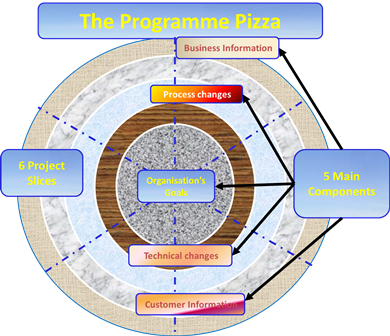
Some years ago some colleagues and I discussed concepts for explaining how projects must fit into programmes, so that each slice of a project would provide benefits, and all of them would combine to fulfil the overall goal. Delivered in slices, or as Tranches as we called them, each of them would help achieve measurable benefits. Combined they achieved the agreed goal. A bit like a pizza, The Programme Pizza.
In this example you have six separate projects, each of which is able to deliver part of each of the components. The organisation needs to improve the way it creates and uses customer and business inforation, there will be some technical changes, and processes will also change.
It has devised a set of six projects all of which need to be maanged in accordance with the programme as a whole in order to realise the organisation's goals.
Each of these projects will provide some of the benefits, depicted here for convenience as euqal parts of the slice.
Provided that all of the projects share essential approaches - a common language, a set of common governing protocols or 'rules', and an agreed way of sharing information during hte programme - everyone involved should be able to work together, following a consistent approach.
They can share the approach to risk management, progress management, communications, reporting, cost management, and success measurement.
And if they have any issues that might affect any of the pther projects and therefore the programme as a whole, they can share thos issues too, enabling the issues to be resolved, and progress made.
This approach reflects the essential conditions for managing successful programmes.
To discuss how to set up a project office and a programme please contact us.